Writers, we need to talk about AI
While we're policing each other's em-dashes, the industry is quietly making decisions about AI that will shape the future of writing as a profession.
About eighteen months ago, during an agent Q&A as part of a prestigious writing programme, I asked a leading literary agent what she thought the future was for aspiring authors in an age of AI.
Her response? We shouldn't worry ourselves about it. Behind the scenes, agents and industry professionals were working it out. And, I quote: "if you're really a writer, you're going to write, regardless."
I'd asked the question hoping to be reassured. I wasn't.
Yes, writers are gonna write. But there's writing for your own private pleasure, and then there's writing as a profession: a talent you hone and craft, in the hopes that your work might reach a broad readership, receive professional support, and - who knows - even earn you a living. By conflating the two, what she was really saying was: you're all prepared to work for free, so my supply of potential clients won't dry up any time soon.
And it isn't. If agents' inboxes are anything to go by, more of us are writing than ever before. Maybe this is because people are using AI to write for them, or to edit for them, but I also think in a meaningful subset of cases it's because they've seen a machine producing coherent text and thought for the first time: if a computer can learn to do that, then maybe I can too. Also, as AI increasingly moves in on our regular work, people are increasingly finding themselves with more time to pursue their passions, including writing.
In paid one-to-one sessions with agents (which is a juicy topic for another day), I've been told that the number of queries they receive has risen, but also that the quality has shifted. It used to be relatively straightforward to sort the talented submissions from the rest, but now, with authors using AI to assist them in writing their query letters and synopses, it's getting harder to sort through.
So for aspiring writers, AI is already changing the landscape of submissions and our chances of being found and represented.
What of our future if we do manage to make it through?
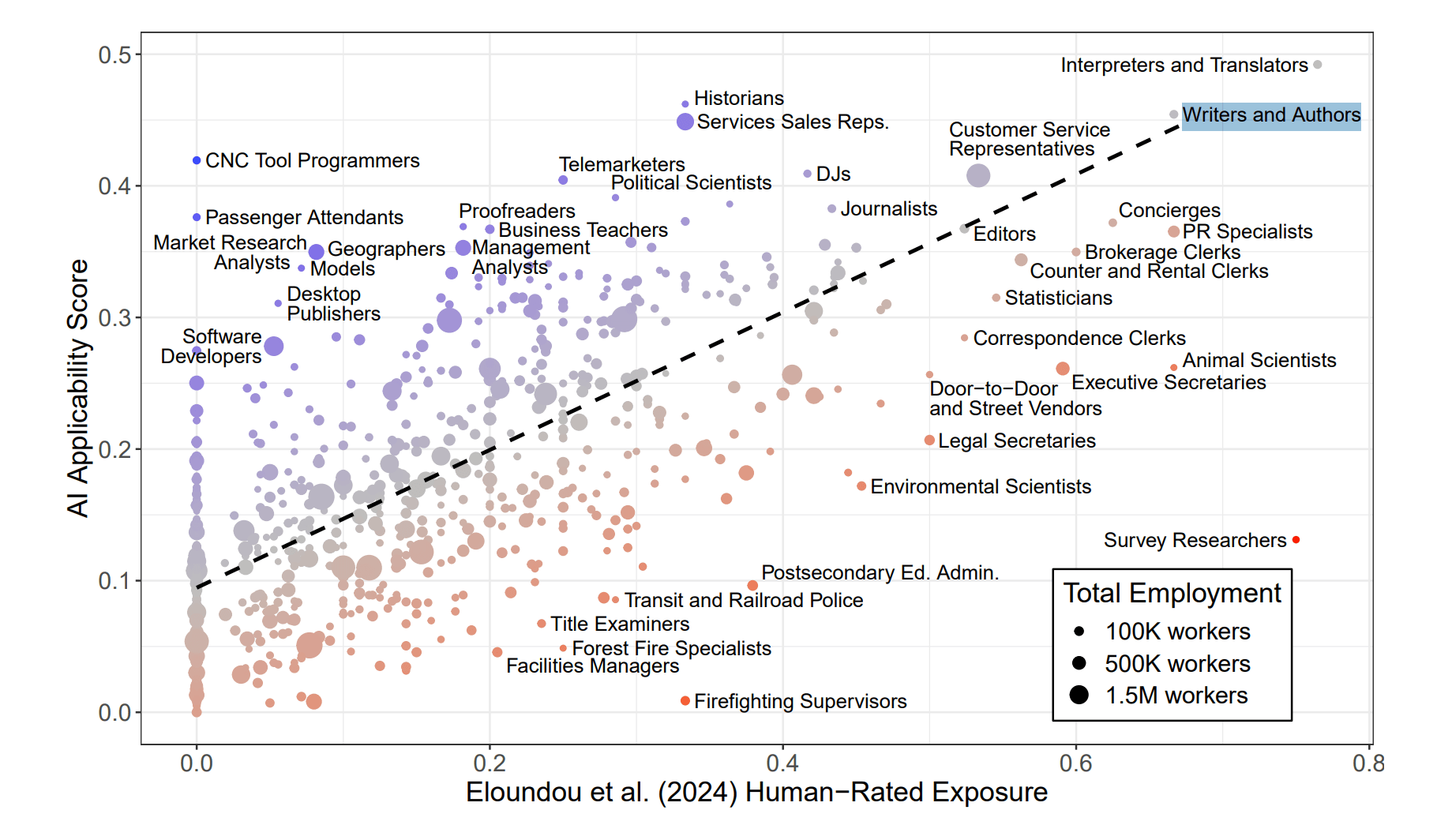
Well, as you can see from the chart below, writing as a profession is consistently ranked among the most at risk from AI automation.
Ah! But AI will never be good enough to rival human writing, the argument goes. The tells are easy to spot.
I agree that's mostly true currently, particularly for someone unskilled in prompt engineering. But it's madness to assume it will stay this way. And even if it did, it's a mistake to assume people would care.
I used to work in TV production. I would sit at home with my family and scream at the television every time the sound recordist's boom mic dropped into shot. I can't believe they left that in, I'd cry. My family didn't even notice. I'd have to rewind the show to make them see it. And even then, they wouldn't care. Craft wasn't important to them. Entertainment was.
The same is true of writing. We like to tell each other people won't want to buy books written by machine intelligence. But think about what an unusual subset of people we are. We are authors. We love writing. We read acknowledgements. We care about who wrote something.
We are not the general public.
Think about an industry you don't have the same passion for. Do you know who directed the last television series you loved? Do you know who designed your phone? Do you care? Most people don't read author bios. They read books because they want to be entertained, or moved, or taken somewhere else for a few hours. And if an AI can do that at a fraction of the cost of commissioning a human writer, do we really think publishing houses won't take that deal?
Bloomsbury, one of the world's largest publishers, has already partnered with Google Cloud for AI-powered publishing infrastructure and appointed a Head of AI Innovation. Their founder and chief executive has said that AI can help writers overcome writer's block and get started on their next project. The question isn't whether this is coming. It's how we navigate it.
I personally love writing, and I also find AI genuinely fascinating. I don't think these things are in conflict. But I do think the current tendency to cancel anyone who acknowledges the situation - or who has so much as a whiff of an emdash in their writing - is making things worse. We can't collectively negotiate a future we refuse to discuss.
There are questions I think we need to be asking urgently. How do readers who value human authorship find and authenticate it? What does a publishing landscape with distinct tiers - AI authored, AI assisted, human only - actually look like in practice? Who benefits and who gets left behind? I'll be writing about the authentication question separately, because it deserves more space than I can give it here.
I don't have any answers. But I know I can't come up with them alone, and I know nobody else is going to have this conversation for us. Not our agents. Not our publishers.
That agent at the writers' programme was right about one thing: writers gonna write. So let's write about it. Let's talk about it, openly, without the witch trials, without the performative outrage, and without demonising a technology that tells us far more about the humans who wield it than about itself.